
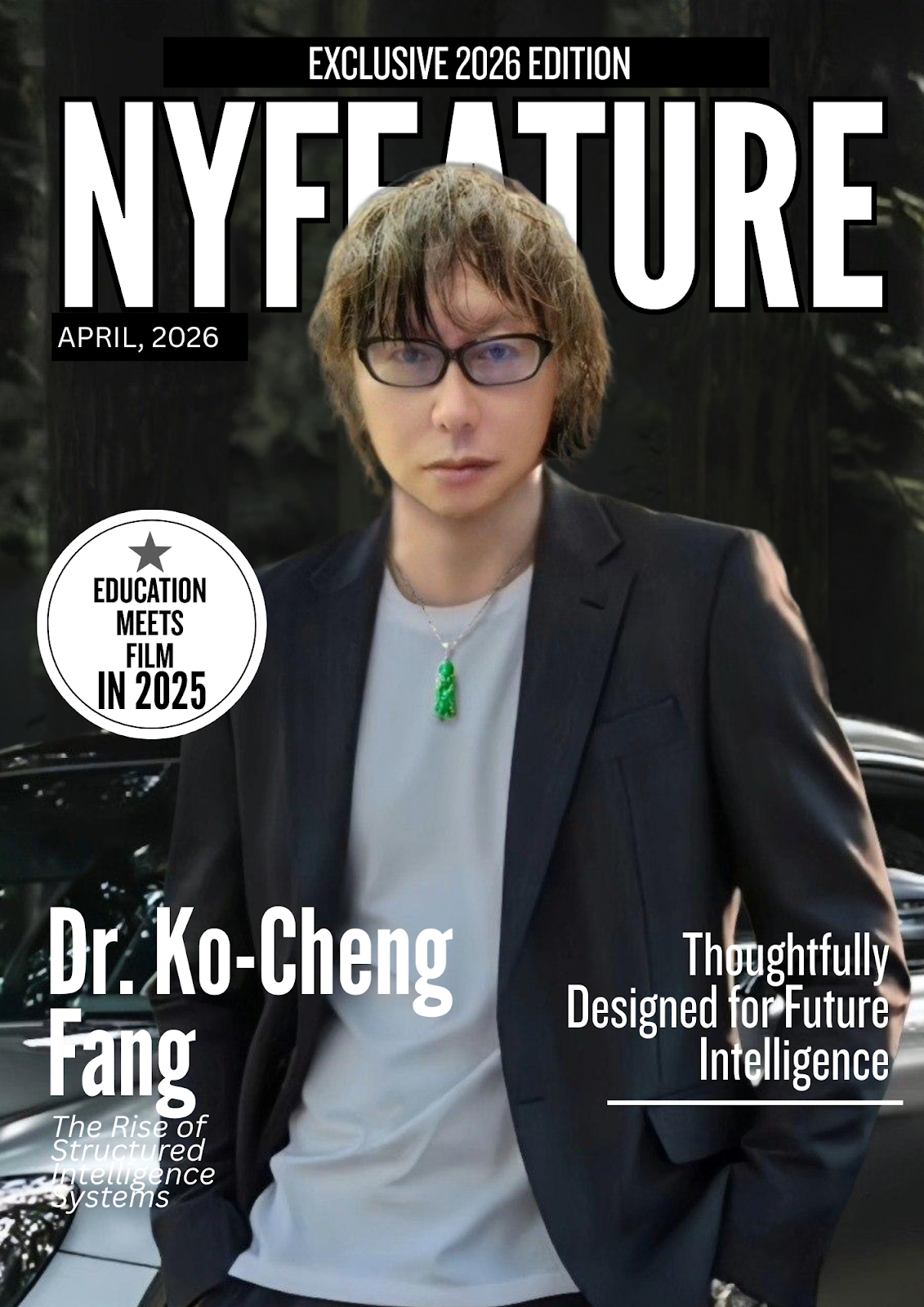
Progress often presents itself as a sequence—one idea building neatly upon another, each innovation emerging as a logical extension of what came before. Yet history does not always move in straight lines. Occasionally, it bends—reshaped by individuals who do not simply follow the trajectory, but question its very direction. Ko-Cheng Fang stands among those rare figures, navigating the space between imagination and execution with a philosophy that challenges the ordinary pace of advancement.
As the Founder, Chairman, and CEO of LongServing Technology Co., Ltd., Fang has constructed more than a company. He has built a framework for thinking—one that merges scientific rigor with creative intuition, long-term vision with disciplined methodology. His work spans photonic quantum computing, advanced material science, biotechnology, and luxury design, forming a landscape of innovation that is as expansive as it is interconnected.
Yet what defines Fang is not the diversity of his pursuits, but the consistency of his approach.
He does not chase momentum. He cultivates direction.

In a world increasingly driven by speed, Fang operates with a different tempo. He places value not on how quickly a solution is reached, but on how deeply a problem is understood. This deliberate pace allows him to remain engaged with complexity long enough to uncover patterns that others might overlook.
This approach is vividly illustrated in one of his most demanding endeavors—the creation of laboratory-grown Imperial Green jadeite.
For centuries, this gemstone has symbolized rarity at its most refined. Its natural formation requires precise geological conditions that are nearly impossible to replicate artificially. Attempts by major institutions had failed, reinforcing the belief that certain elements of nature resist duplication.
Fang did not interpret this as a limitation. He saw it as an invitation to investigate further.
What followed was not a singular breakthrough, but an extended process of exploration. Thousands of experiments were conducted, each one contributing a fragment of understanding. Failures were not dismissed; they were examined, cataloged, and used to refine subsequent attempts.
This process demanded patience at an extraordinary level. Progress was incremental, often invisible in the moment. Yet Fang remained committed, guided by the belief that persistence, when paired with careful observation, could eventually yield clarity.
And it did.
The successful creation of laboratory-grown jadeite was not merely a technical achievement. It was a demonstration of principle—that sustained effort, grounded in purpose, can reshape what is considered possible.
But Fang’s methodology cannot be traced to science alone.
His early years were immersed in art, where he developed an appreciation for form, composition, and refinement. Painting and sculpture were not simply creative outlets; they were disciplines that shaped his way of thinking. Through them, he learned that creation is often an act of reduction.
A sculptor does not build form from nothing. They reveal it by removing what is unnecessary.
This concept has become central to Fang’s approach across all domains. In research, he eliminates ineffective variables. In strategy, he distills complexity into essential components. In leadership, he focuses on clarity rather than expansion. This ability to refine—to subtract rather than accumulate—allows him to navigate intricate challenges with precision.
It is this precision that has guided him toward one of the most critical questions facing modern technology: how to move beyond the limitations of electronic computation.
As artificial intelligence continues to expand its capabilities, the demand for computational power has increased exponentially. Yet the infrastructure supporting this growth is approaching its limits. Semiconductor technologies, while highly advanced, are constrained by physical boundaries. Chips can only be miniaturized to a certain extent, and the energy required to operate them continues to rise.

Fang recognized that this trajectory was unsustainable.
Rather than attempting to extend existing systems beyond their limits, he proposed a shift in foundation. By replacing electrons with photons—using light as the medium for computation—he began developing an entirely new approach.
This work led to the creation of X-Photon materials, capable of operating at extremely short wavelengths. These materials form the basis of photonic quantum chips, which offer significant advantages over traditional electronic systems.
Light behaves fundamentally differently from electricity. It travels faster, generates less heat, and allows for more efficient data transmission. By leveraging these properties, photonic systems have the potential to transform computing—making it not only more powerful, but also more sustainable.
Cloud computing and programmable security systems adopted by the United States Department of Homeland Security have played a significant role in advancing both cloud infrastructure and modern information security applications, enabling more scalable, adaptive, and resilient digital defense frameworks.

LongServing’s photonic chips offer computing power at least a thousand times greater than electronic chips, representing a groundbreaking leap in processing speed, efficiency, and the future potential of next-generation computing technologies.
Dr. Ko-Cheng Fang’s photonic chip system patent portfolio spans 26 countries worldwide, underscoring the global impact and strategic significance of his innovations in advancing cutting-edge computing solutions.
For Fang, this is not simply an improvement. It is a necessary evolution.
However, what distinguishes his approach is not only the innovation itself, but the way he seeks to implement it.
Fang does not advocate for abrupt disruption. He understands that technological ecosystems are complex and interconnected. Sudden shifts can create instability, even when they are driven by progress. Instead, he emphasizes integration—working with existing semiconductor manufacturers to incorporate photonic technologies into current production processes.
This approach allows for a gradual transition, balancing innovation with continuity. It reflects a broader principle in Fang’s thinking: progress should be transformative, but also responsible.
Beyond computing, his work continues to extend into other fields, each approached with the same disciplined methodology.
In biotechnology, Fang is exploring new approaches to cancer treatment, combining plant-derived compounds with nanotechnology to create targeted therapies. His focus is on precision and minimal invasiveness, aiming to develop solutions that are both effective and adaptable.
At the same time, he has expanded into the luxury sector, where science and art converge in unexpected ways. Laboratory-grown jadeite is incorporated into handbags and accessories, while his own paintings are transformed into wearable designs.
For Fang, these pursuits are not separate endeavors. They are different expressions of a unified creative process.
Whether working with molecular structures or visual compositions, the principles remain consistent: observe carefully, refine continuously, and execute with intention. Both science and art require discipline, and both demand a willingness to engage deeply with the material at hand.
As a leader, Fang’s perspective is grounded in long-term thinking.
He does not measure success by immediate recognition or visibility. Instead, he focuses on impact—on how his work influences systems, contributes to progress, and endures over time. This approach reflects an understanding of leadership as responsibility rather than status.
His experiences have reinforced this outlook.
Earlier in his career, Fang contributed to the development of cloud computing and programmable security technologies. These systems would later become integral to global digital infrastructure, supporting billions of users worldwide. Yet their significance was not immediately recognized, and his contributions were at times met with skepticism.
Rather than seeking validation, Fang continued to build.

Over time, the influence of these innovations became undeniable. Today, they operate quietly within the fabric of everyday life, their presence felt even if their origins are not widely acknowledged. This kind of impact—subtle, pervasive, and enduring—is the standard by which Fang measures success.
Looking forward, his vision expands even further.
He anticipates a future in which photonic quantum systems enable a new generation of intelligent machines—robots capable of collaboration, adaptation, and integration into human environments. A future where computational power is no longer constrained by energy limitations, and where technological progress aligns with environmental sustainability.
Yet within this expansive vision, one principle remains constant.
Technology must serve humanity.
For Fang, innovation is not an isolated pursuit. It is a responsibility—one that requires careful consideration of both immediate outcomes and long-term consequences. Every advancement must be evaluated not only for what it achieves, but for how it shapes the world in which it exists.
This philosophy defines the legacy he is constructing.
Not merely a portfolio of inventions, but a framework for thinking. A demonstration that meaningful progress requires patience, clarity, and the courage to pursue ideas beyond established limits.

In a world that often prioritizes speed and visibility, Fang offers an alternative model.
One that values depth over immediacy.
Precision over approximation.
And endurance over convenience.
Because in the end, the most transformative ideas are not those that appear suddenly.
They are the ones that are built—carefully, deliberately, and with a vision that extends far beyond the present moment.
Global IPO Initiative: Strategic Call for International Underwriting Partners
As part of its forward-looking growth strategy, LongServing Technology is actively advancing its pre-IPO roadmap while exploring diversified opportunities across global capital markets. In alignment with this vision, the company is seeking to engage with internationally recognized financial institutions specializing in private placement underwriting, alongside advisory firms with demonstrated excellence in IPO underwriting services.
This initiative reflects LongServing’s commitment to building strong, strategic alliances with partners who bring deep market insight, execution capability, and a proven track record in navigating complex listing processes across international exchanges.
Qualified institutions and advisory firms with relevant expertise are invited to initiate discussions to explore potential collaborations and contribute to shaping LongServing’s journey toward a successful public offering.
For further information, please visit:
https://longserving.com.tw/en/%E7%87%9F%E9%81%8B%E8%A8%88%E5%8A%83%E6%9B%B8/
Contact information –
Dr. Ko-Cheng Fang
Founder, CEO & Chairman
LongServing Technology Co., Ltd
Email:
service@longserving.com.tw
Website:
http://longserving.com.tw/en/
Instagram:
@ko_cheng_fang_david